03

Reading a cultural shock in real time

Competitive · Portfolio strategyEstée Lauder Companies
UX ResearchExperience StrategyProduct & Design LeadershipAI & Insight Systems
The problem

In-store experience halted globally within weeks. Digital demand surged across the portfolio overnight, and the things that actually differentiated the brands, consultation, sampling, education, and shade matching, had no digital equivalent. Competitors were shipping responses daily and nobody could tell which moves were signal and which were panic.

My role

Directed the cross-brand UX audit and competitive intelligence initiative across the portfolio, delivered as a 112-page executive research report organized into 17 feature and function categories.

Approach
  • Scanned 50+ brands, inside the portfolio and well outside the category
  • Logged every example as an observation, a recommendation, and an open question
  • Mapped in-store value drivers to their digital equivalents
  • Built a cross-brand gap model to sequence rollout
Data sources
  • UX audit and heuristic analysis
  • Fullstory behavioral analytics
  • Competitor, social, and CRM monitoring
Report
112
Pages, delivered to executive stakeholders in April 2020
Brands scanned
50+
Beauty, luxury retail, apparel, food, and mobility
Categories
17
Feature and function areas, from live chat to tracking pages
Owners
3
Functions the recommendations were routed to by name
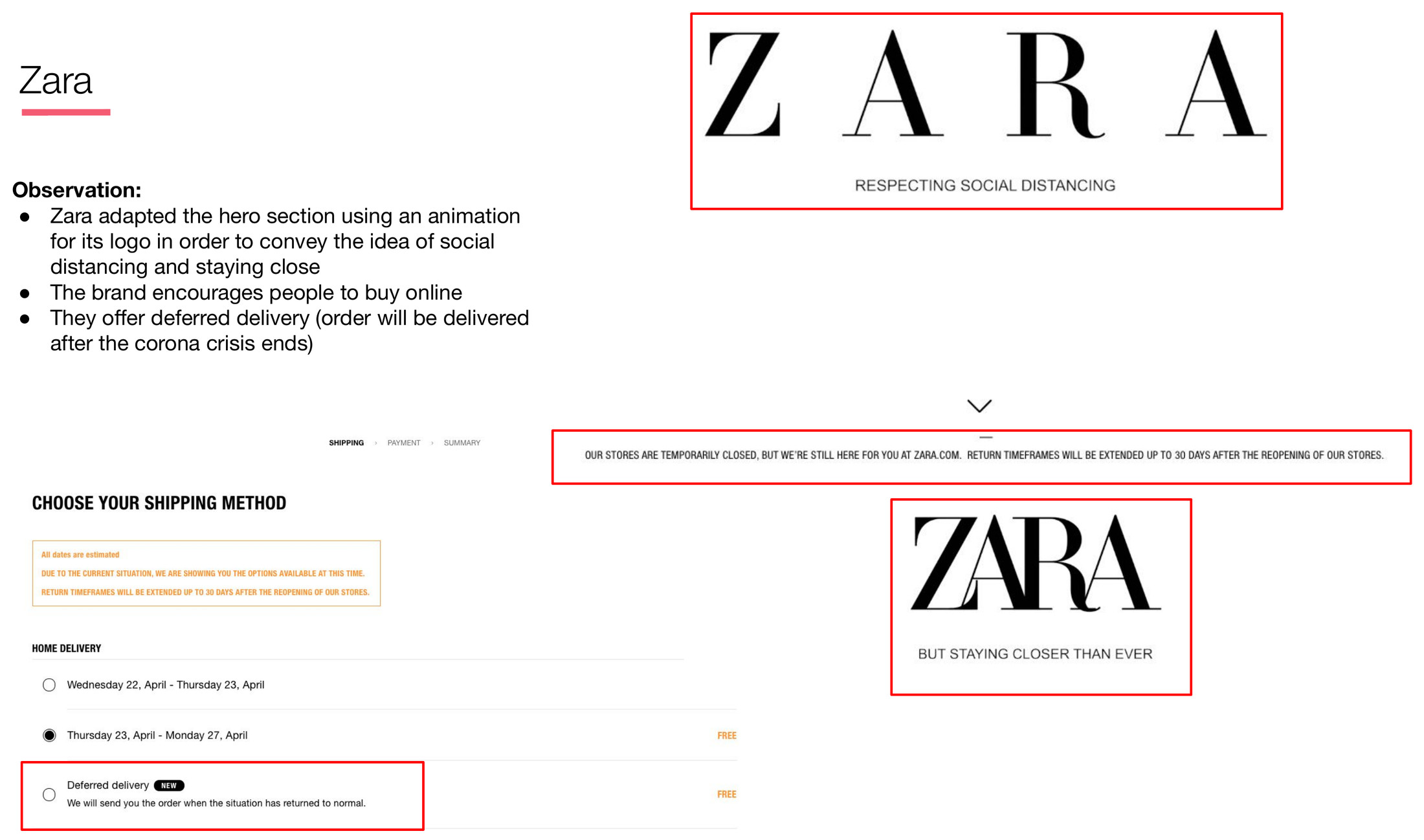
Looking outside beauty was the point. Uber's rider safety email and Zara's deferred delivery answered questions the category had not thought to ask yet.
/ Where attention moved
03 / Cultural shock

Behavior shifted toward
human support and purpose

Source: Fullstory behavioral analytics, engagement lift by content type
Live consultation
+78
Skill building
+62
How-tos
+33
Masterclasses
+16
Alongside the behavior, users were actively seeking cruelty-free clarity, manufacturing transparency, recycling commitments, and a brand's actual COVID response. Purpose stopped being an About page and became a purchase input.

Three gaps the portfolio
was losing ground on

Percentages show relative competitive presence across peer brands.
Dynamic sitewide messaging37.9%

Gap: inconsistent communication brand to brand. Opportunity: one reusable sitewide module every market and brand could deploy.

Order tracking31%

Gap: customer service absorbing the cost of shipping delays. Opportunity: proactive logistics messaging before the contact happens.

Virtual services suite24.1%

Gap: live services fragmented across brands and vendors. Opportunity: a centralized experience hub rather than nine separate builds.

Lowest presence, highest long-term value. That inversion is what made it worth arguing for.
/ The coverage gap
03 / Cultural shock

Eight of seventeen categories
had no portfolio example at all

Counting the report's own entries by where each example came from turns the scan into a gap model. The first nine categories were things our brands were already doing somewhere. The last eight existed only outside the portfolio, and the largest of them, live video consultation, had twelve competitor examples against none of ours.

Recounted from the report's 64 main-body entries. The chart is a present-day reading of the April 2020 findings, not a page from the deck.
Already running inside the portfolio9 categories · 23 portfolio examples, 6 outside
Feature areaExamples loggedIn / out
Donating products
7 / 0
Shoppable livestream
3 / 0
Video call on live chat
3 / 0
Virtual try-on
3 / 0
Helping the salons
3 / 1
Earth Month, carbon calculator
1 / 5
Image recognition
1 / 0
Dynamic pop-ups and messaging
1 / 0
Instagram masterclass
1 / 0
Found only outside it8 categories · 0 portfolio examples, 35 outside
Virtual appointments via video chat
0 / 12
Miscellaneous
0 / 7
Live chat
0 / 4
B2C hygiene products
0 / 3
Content curation
0 / 3
Innovation
0 / 3
Tracking pages
0 / 2
360 degree experience
0 / 1
Portfolio brand example Outside brand example No example logged
The shape of the distribution was the argument. Where our brands already had a version of something, the job was consistency. Where they had none, the job was a decision, and the categories with the thinnest internal coverage were the ones with the most competitor activity.
/ Outside the category
03 / Cultural shock

The two entries that changed
what we thought to ask

Neither of these is a beauty brand, and neither is doing anything a competitive scan of the category would have surfaced. A rideshare company writing safety instructions into a transactional email, and a retailer offering to hold your order until the crisis ended. Both answered a question our brands had not framed yet.
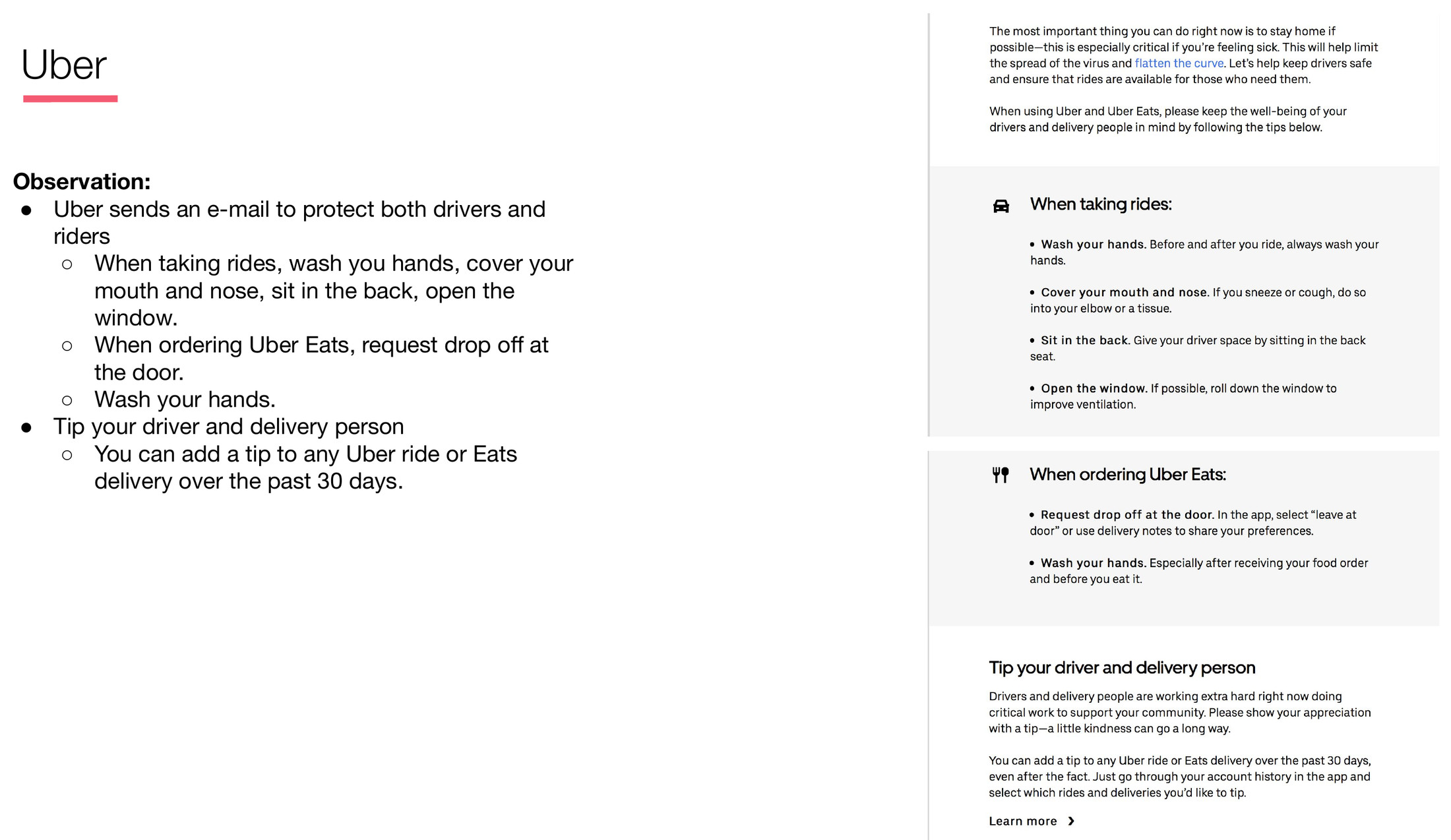
Deck entry on a rideshare company's coronavirus email, which gave riders and drivers specific behavioural instructions and prompted retroactive tipping
Duty of care in a receiptSafety instruction placed inside the transaction rather than on a policy page, plus retroactive tipping on rides already taken. Purpose expressed as a product decision, not a statement.Open full size
Deck entry on an apparel retailer's response: a homepage treatment conveying social distancing and an offer of deferred delivery until the crisis ended
Deferred deliveryBuy now, delivered after the crisis. It converted an obstacle, unreliable logistics, into an offer, which was the exact problem the portfolio was absorbing through customer service.Open full size
Thirty-five of the sixty-four logged entries came from outside the portfolio, and the most useful ones came from outside the category entirely. Scanning peers tells you where you rank. Scanning further tells you what you have not thought of.
/ Routed by owner
03 / Cultural shock

The report ended in three
lists, not one appendix

Every recommendation worth acting on was rewritten under the function that had to act on it. A product manager reading the last three pages sees only what is theirs, phrased as something they could take into a sprint planning conversation.

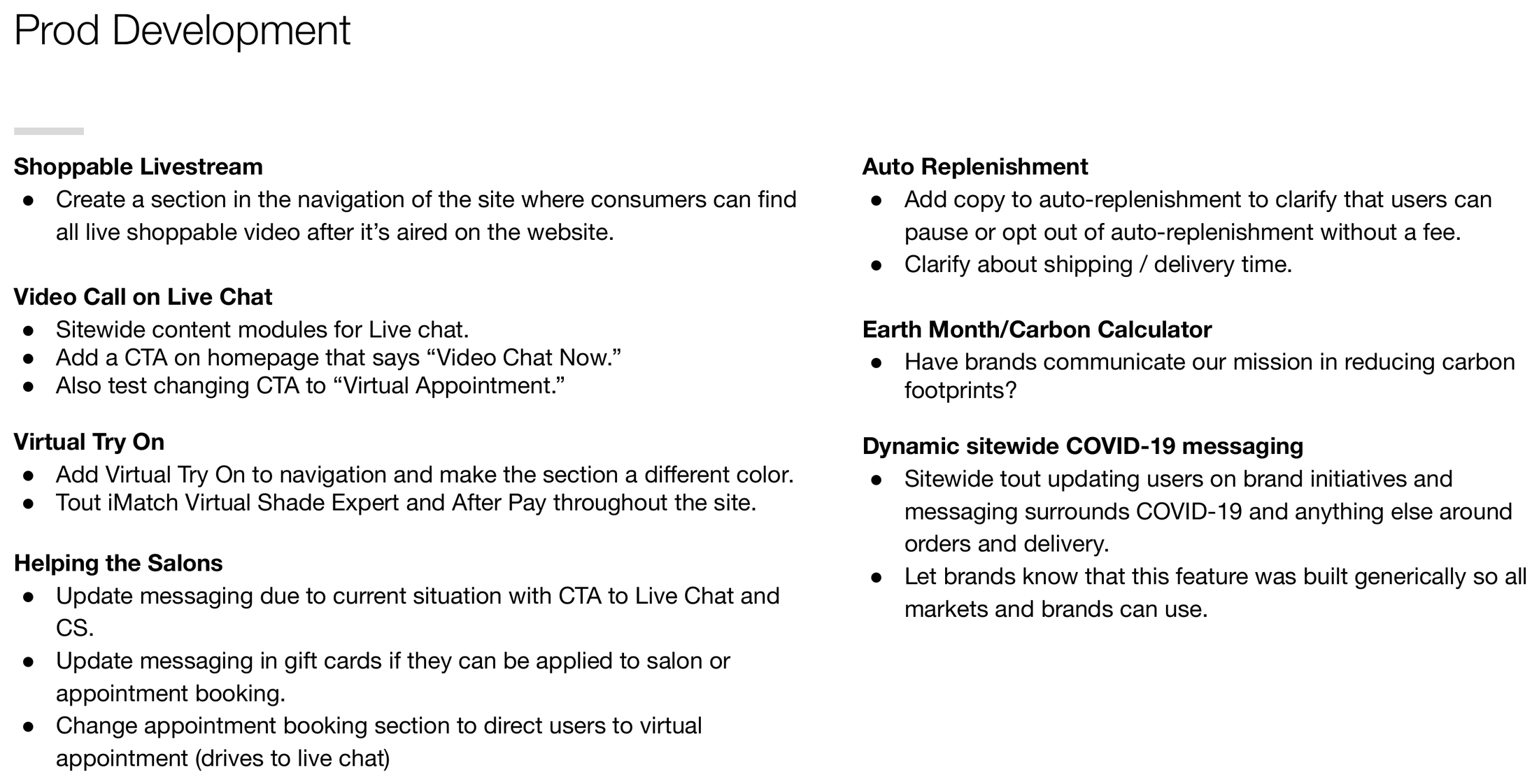
Product development takeaways: navigation changes for shoppable video and virtual try-on, live chat modules, auto-replenishment copy, and a reusable sitewide COVID messaging tout
Product developmentNavigation and on-page changes. Where to surface shoppable video, what to rename the video chat CTA, what the auto-replenishment copy had to clarify about pausing and shipping.Open full size
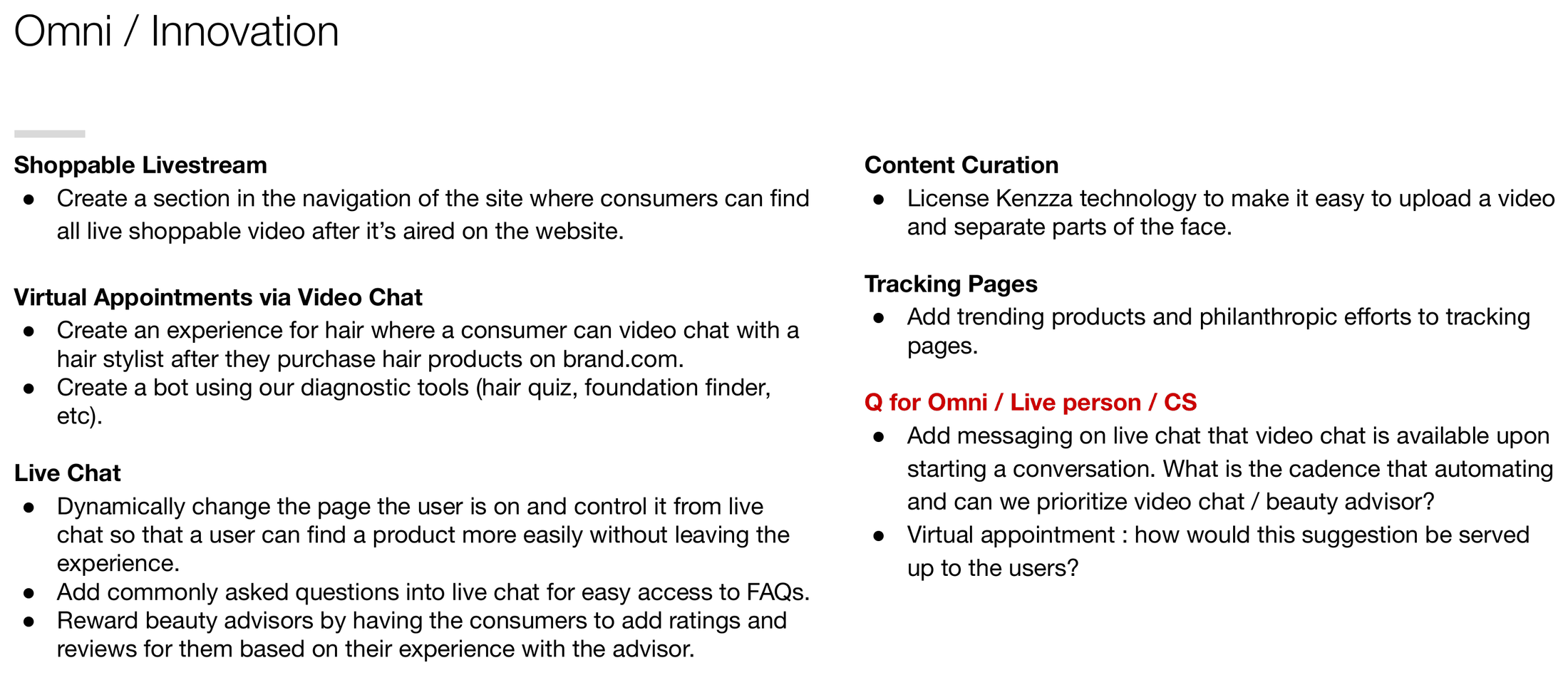
Omni and innovation takeaways: video consultation for hair, a diagnostic bot built from existing quiz tools, live chat page control, advisor ratings, and content licensing
Omni and innovationNew capability rather than new pages. Video consultation after a hair purchase, a bot built from the quiz tools we already had, and letting an advisor be rated like a product.Open full size
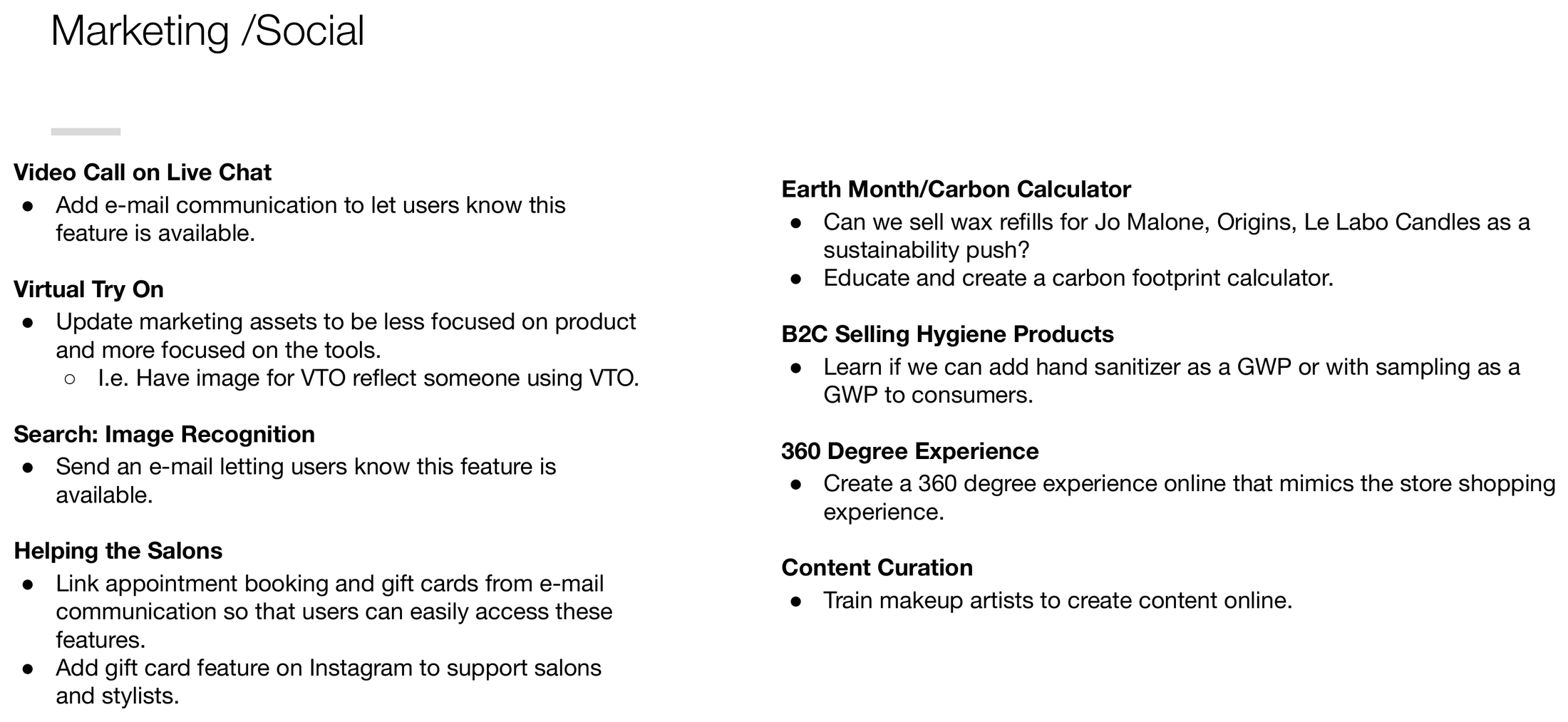
Marketing and social takeaways: feature awareness email, redirecting virtual try-on assets toward the tool rather than the product, gift card and sustainability pushes
Marketing and socialMostly awareness. Several features already existed and nobody knew. The asset note is the sharpest one: show someone using virtual try-on rather than showing the product.Open full size
Fifty of the eighty-three entries produced a recommendation. The rest were logged as observations and left there, which is what kept the three lists short enough to be read.
/ How the report was built
03 / Cultural shock

A scan is a list.
This was built to be acted on.

Competitive research usually arrives as a folder of screenshots and dies there. Two structural choices stopped that.

Every entry carried three parts

Observation, recommendation,
open question

  • Observation. What the brand actually did, in plain terms
  • Recommendation. What we should do about it, specific enough to scope
  • Open question. What we would need to know first. Do we have analytics on this. Which vendor powers it. Which other brands are about to launch the same thing
Takeaways routed by owner

Three functions,
not one appendix

  • Product development. Navigation changes, auto-replenishment copy, virtual try-on placement, sitewide COVID modules
  • Omni and innovation. Live chat behavior, video consultation for hair, diagnostic bots, content licensing
  • Marketing and social. Feature awareness email, asset direction, sustainability and gift card pushes
Naming the open question beside every recommendation is what kept a competitive scan from becoming a wish list.
/ The routing model
03 / Cultural shock

Almost half of it could not
be shipped by one team

Mapping every recommendation to the function that had to act on it produced the finding that mattered more than any single competitor example. Of fourteen areas, 6 needed two functions moving together. Live chat was worthless without marketing telling anyone it existed. Virtual try-on needed a navigation change and a new asset direction, and neither team could do the other's half.

Product
development
Omni and
innovation
Marketing
and social
Shoppable livestream
Video call on live chat
Virtual try-on
Salon support
Earth Month, carbon calculator
Content curation
Auto-replenishment
Sitewide COVID messaging
Virtual appointments
Live chat behaviour
Tracking pages
Image recognition search
B2C hygiene products
360-degree store experience
Areas routed
7
5
8
Key
● this function owned part of the work  ·  ○ not routed here
Drawn from the takeaways section of the April 2020 report, where the recommendations were split by owning function rather than collected in one appendix. Rendered here from that source; the report itself carried the routing as three lists.
/ What it produced
03 / Cultural shock

Four in-store value drivers,
translated into things we could build

Consultation, sampling, education, and shade matching, each mapped to a digital equivalent and sequenced by user demand against brand maturity.
Defined
4
Core in-store value drivers named, then translated into scalable digital experiences
Prioritized
17
Feature areas ranked through a cross-brand gap model to guide rollout order
Assigned
3
Owning functions received the recommendations directly, with the open questions attached
The challenge was not going digital. It was translating human, high-touch experiences into scalable systems.