04

Gen Z identity and brand relevance

Qualitative · Brand strategyEstée Lauder Companies
UX ResearchExperience StrategyProduct & Design LeadershipAI & Insight Systems
The problem

MAC historically dominated younger beauty communities and was losing retention with Gen Z. As beauty and wellness consumption shifted, the business needed a deeper read on Gen Z motivations, identity signals, and cross-channel behavior.

My role

Led the qualitative initiative to decode Gen Z behavioral drivers across MAC and competitor ecosystems, informing positioning and experience strategy.

Methodology
  • 20 moderated remote in-depth sessions
  • Behavioral patterns synthesized into structural archetypes
  • Discovery, validation, and identity expression journeys mapped
  • Social and cultural influence loops analyzed across platforms
Data sources
  • UserTesting
  • Competitor walkthroughs, user-led
  • Social listening
Gen Z research context
/ Insight
04 / Gen Z identity

Why MAC was losing relevance with Gen Z, and what would close the gap.

What the research found
  • Awareness was not the problem. MAC was recognized and its positioning felt diluted
  • Brand meaning was not articulated anywhere users would look for it
  • The experience did not reflect how Gen Z discovers, evaluates, and engages with beauty
What I drove
  • Identified the behavioral drivers shaping discovery, trust, and brand affinity
  • Mapped competitor ecosystems through user-led walkthroughs to surface expectation gaps
  • Defined priority experience gaps relative to Gen Z-first brands
MAC was not losing Gen Z on awareness. It was losing them on relevance, resonance, and experience.
/ Three themes
04 / Gen Z identity

Transparency is a trust driver, and we underperform on it

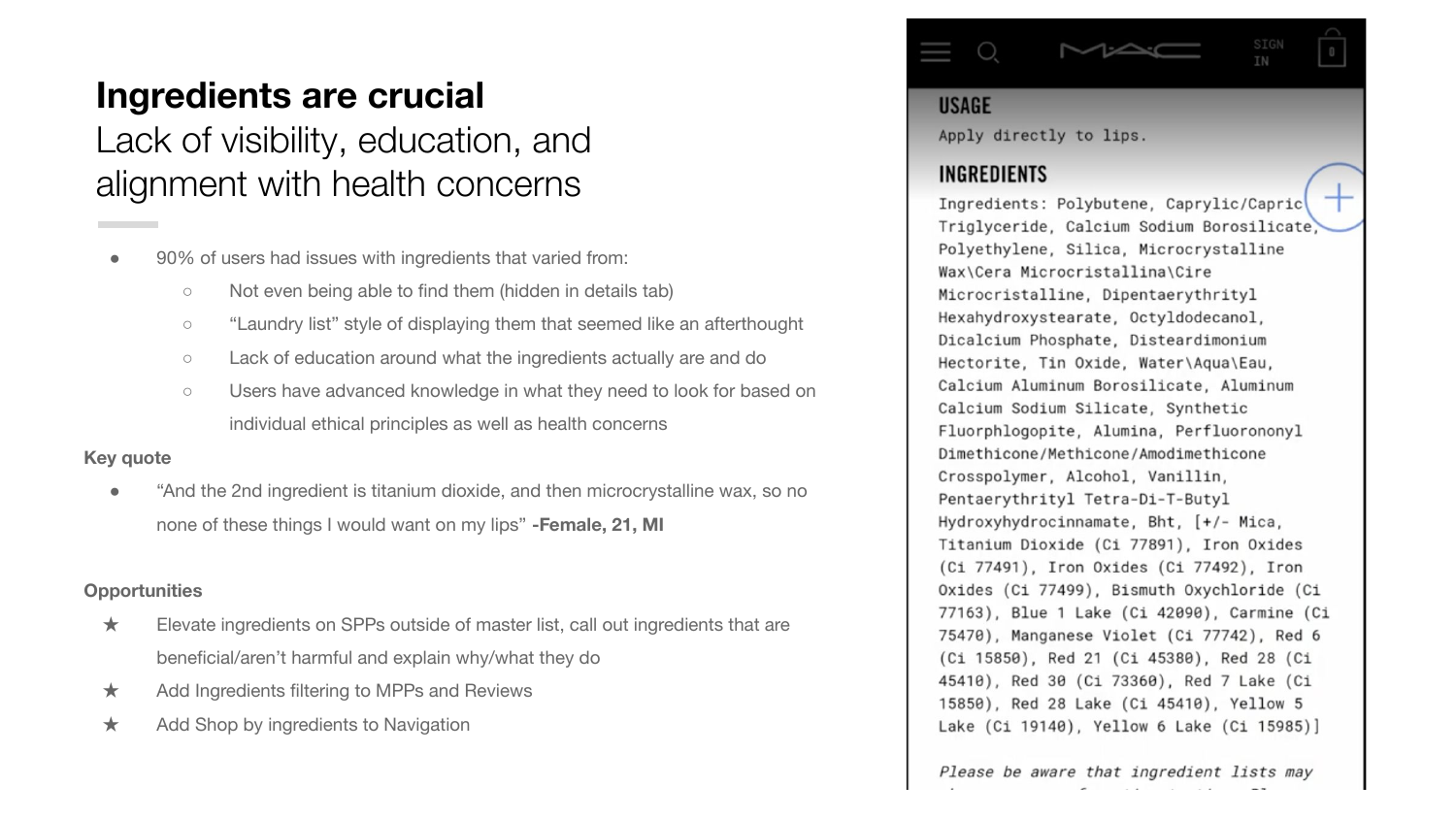
  • Ingredients are buried and presented without context
  • Users expect educational framing, not a compliance listing
  • Ethical and health alignment influences the purchase decision
Opportunity

Near term, elevate ingredient visibility and filtering. Mid term, reframe ingredient transparency as educational storytelling.

Perceived ethical inconsistency erodes credibility

  • Gen Z cross-verifies claims well beyond brand.com
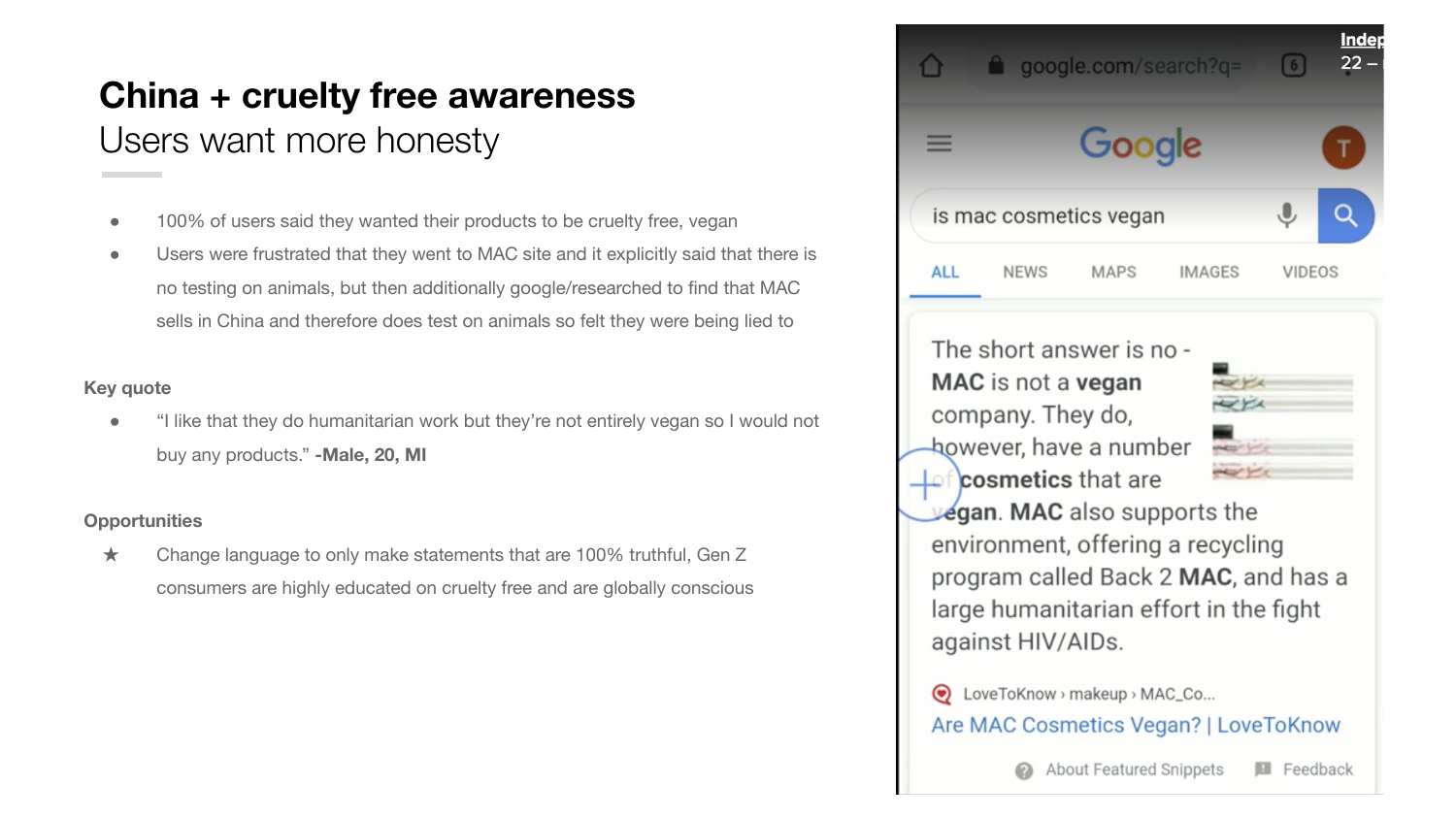
  • China market presence created confusion around cruelty-free positioning
  • Perceived misalignment damaged trust
Opportunity

Make only claims that are fully accurate. This audience is highly educated on cruelty-free standards and globally conscious.

Gender-fluid expression is a growth opportunity

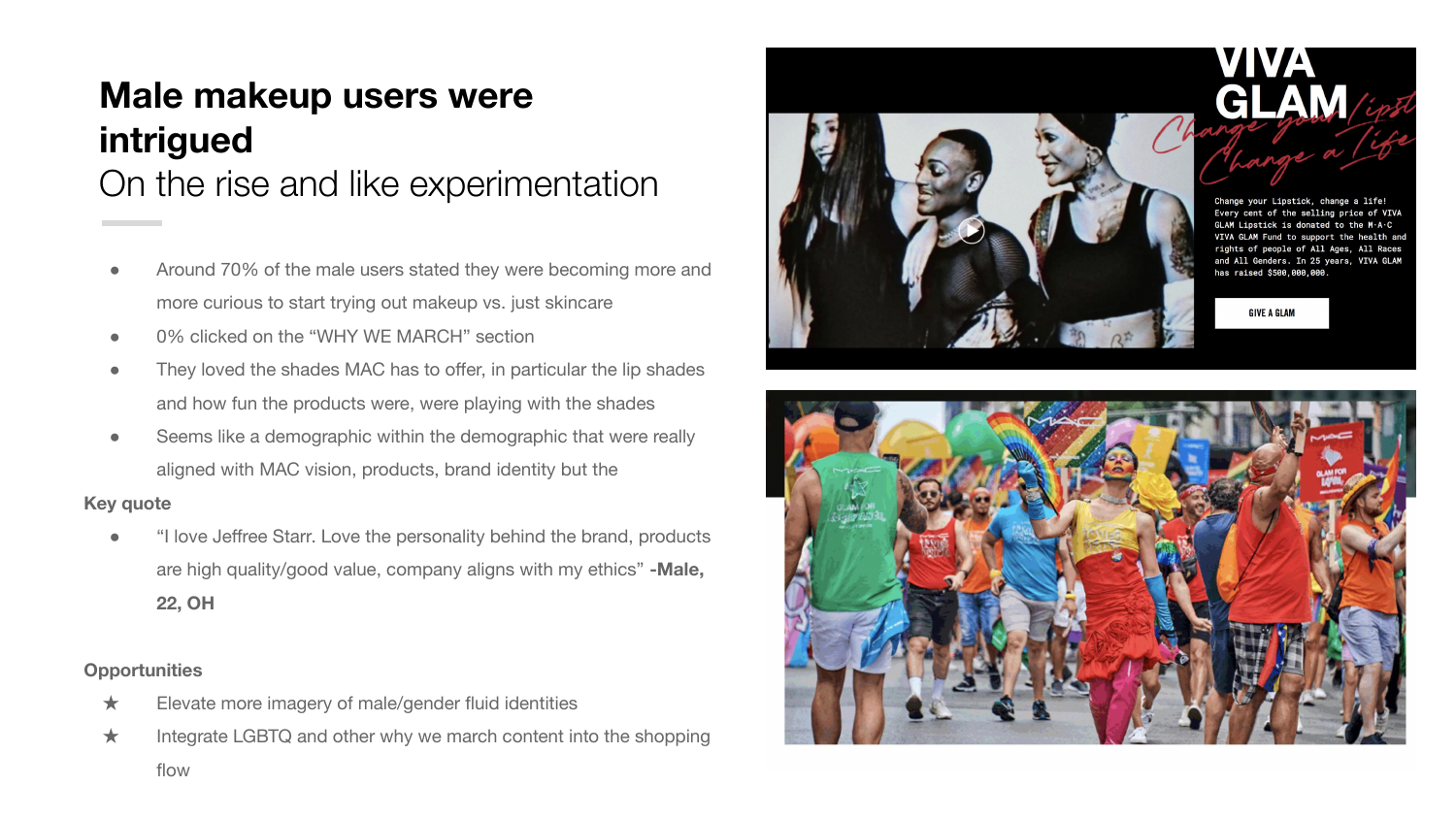
  • Male and gender-fluid users increasingly experimenting with makeup
  • Lip shades resonated particularly strongly
  • Strong cultural alignment with MAC's historical identity
Opportunity

Elevate imagery reflecting this audience and integrate values-led content into the shopping flow rather than isolating it.

Gen Z loyalty is built on radical transparency and cultural alignment, not legacy authority.
/ The sample and the screen
04 / Gen Z identity

Who was recruited, and why
the screen mattered later

Twenty sessions on maccosmetics.com, run in the discovery phase before anything was scoped. Each participant also walked a second site they picked themselves, which is where the competitor loyalty data came from rather than from a list we handed them.

Participants
20
Ages 18 to 24, entry-level, advanced web users
Gender split
13 / 7
Women to men. The male subgroup produced its own finding
Sites walked
2
The brand site, plus one competitor each participant chose
Objectives
6
Discovery, content engagement, brand interaction, friction, and where behaviour originates
The screen

Beyond age and web expertise, the recruit filtered for politically engaged participants who were LGBTQ-identifying or active allies. That was a deliberate choice: the brand's cultural positioning is built on exactly that audience, so the sample had to be able to judge whether the positioning landed.

Why it mattered

It turned one finding from a soft observation into a hard one. When nobody in that sample opened the brand's own values content, the problem was no longer that the audience did not care. The problem was placement.

/ From the study
04 / Gen Z identity

The findings as they were
delivered to the brand

Twenty moderated sessions on maccosmetics.com, each finding paired with the screen that produced it and the opportunities it opened. Participant quotes are attributed by age, gender, and state only.
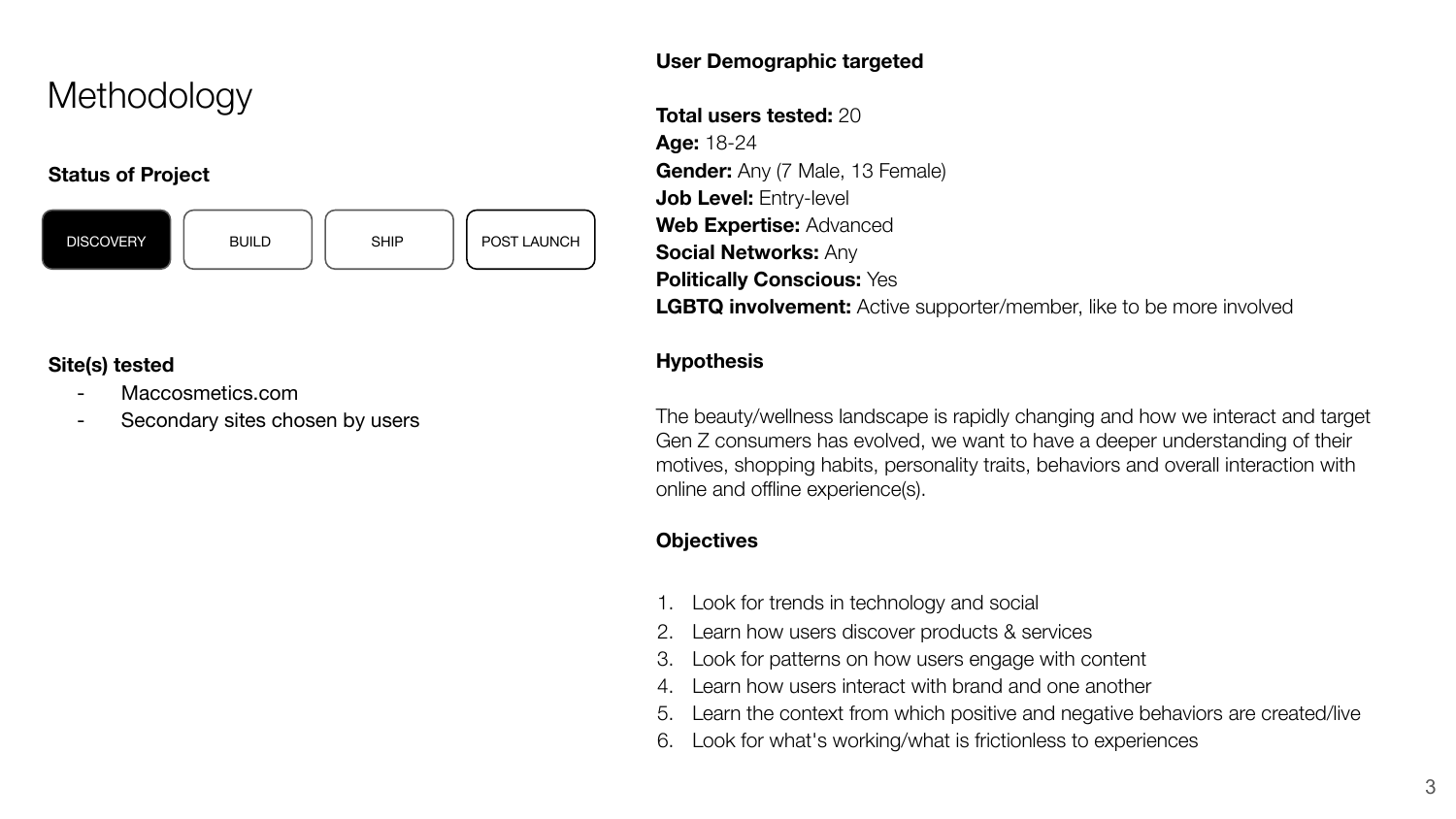
The screen and the hypothesis. Twenty participants aged 18 to 24, entry-level, advanced web expertise, screene
The screen and the hypothesis. Twenty participants aged 18 to 24, entry-level, advanced web expertise, screened on political consciousness and LGBTQ involvement because the brand's positioning depended on both.
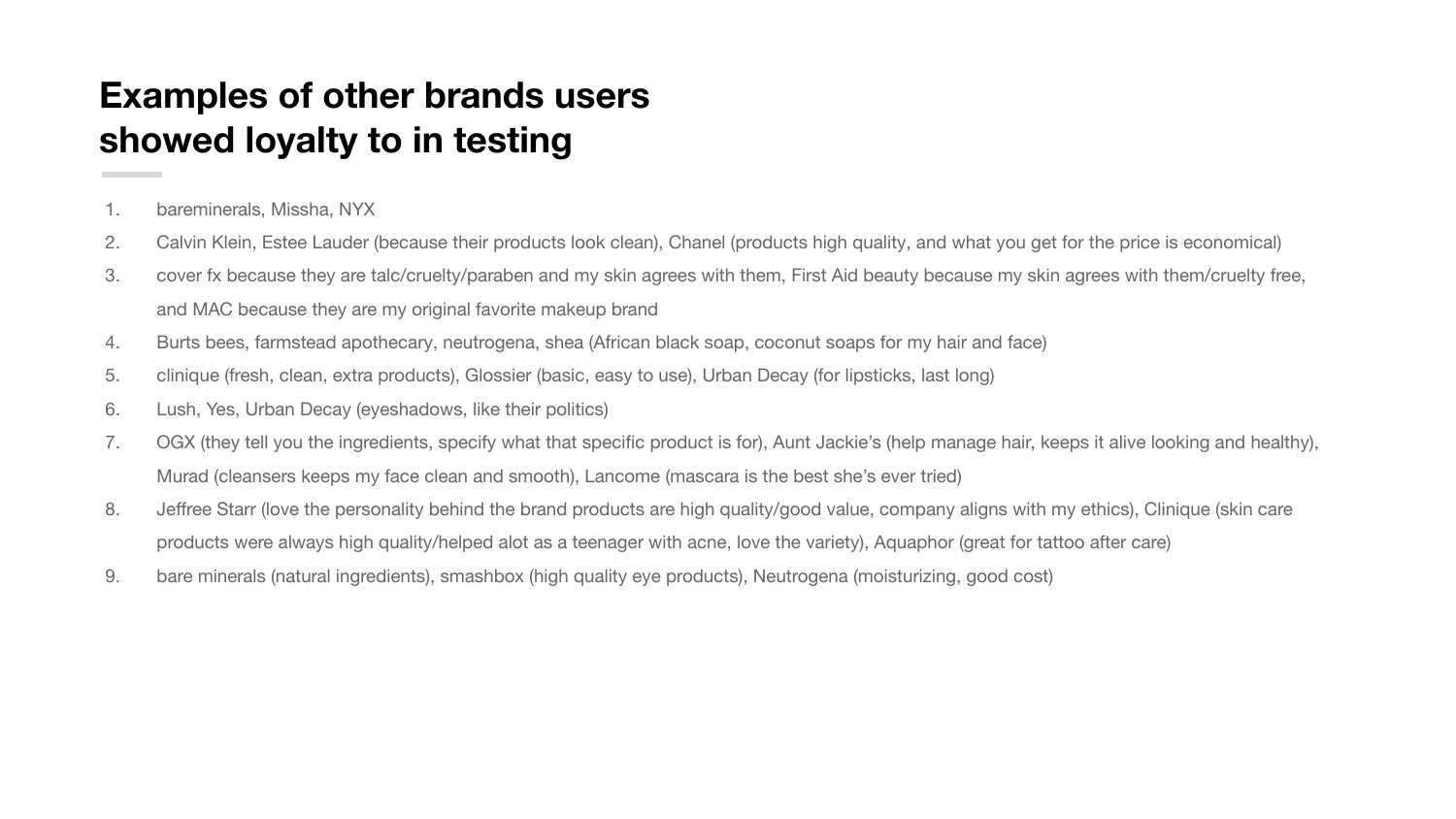
Unprompted competitor loyalty, captured verbatim. Users named the brand and the reason in the same breath, and
Unprompted competitor loyalty, captured verbatim. Users named the brand and the reason in the same breath, and the reasons were almost never product performance.
Ingredients, the finding that moved fastest. 90% of users hit a problem: buried in a details tab, presented as
Ingredients, the finding that moved fastest. 90% of users hit a problem: buried in a details tab, presented as a laundry list, and unexplained. The opportunity set became ingredient filtering on listing pages and a shop-by-ingredient nav path.
The credibility gap. 100% wanted cruelty-free and vegan products; users left the site to verify the claim, fou
The credibility gap. 100% wanted cruelty-free and vegan products; users left the site to verify the claim, found the China distribution answer, and came back reading the original statement as a lie.
Male participants were the demographic inside the demographic. Around 70% were moving from skincare toward mak
Male participants were the demographic inside the demographic. Around 70% were moving from skincare toward makeup, and none of them clicked the brand's own identity content.
Why these three

Each finding arrived with a screen recording behind it, a verbatim, and a named opportunity. That structure is what let a brand team act on qualitative work without re-litigating whether twenty sessions was enough.

/ What the numbers said
04 / Gen Z identity

From everybody, to nobody,
on the same subject

Sorted highest to lowest. The top of the list and the bottom of the list are about the same thing, which is the whole finding: unanimous demand for a brand position, and zero engagement with the place the brand had put it.

Cruelty-free expected
100%
Ingredient friction
90%
Cared about the brand stance
90%
Left the site mid-task
80%
Male curiosity in makeup
70%
Learn by watching
50%
Hunted for "About us"
40%
Clicked "Why we march"
0%
100% · Cruelty-free expected
Said they wanted their products cruelty-free and vegan. Not a preference, a condition.
90% · Ingredient friction
Hit a problem with ingredient information: buried in a details tab, listed without explanation, or both.
90% · Cared about the brand stance
Said what the brand stands for mattered to their decision.
80% · Left the site mid-task
Opened another browser window during the session, usually to verify a claim or research the brand.
70% · Male curiosity in makeup
Of the male participants, said they were moving from skincare toward makeup.
50% · Learn by watching
Said video is how they learn, YouTube in particular. None of them opened the video on the site.
40% · Hunted for "About us"
Went looking for brand purpose content, in the footer or through search.
0% · Clicked "Why we march"
The section that held the brand position. Nobody opened it, in a sample screened for the audience it was written for.
/ Synthesis
04 / Gen Z identity

Nothing they asked for was
missing. It was unfindable,
unprioritised, or not believed.

Seven separate observations collapse into three behaviours. Grouping them this way is what made the recommendations sequence instead of compete, because each group has a different owner and a different fix.

01 They verify everything

Claims are a starting point, not evidence. All twenty wanted cruelty-free, then left the site to check, and came back having found the contradiction between the animal-testing statement and the China market. Ingredients were the same pattern: present, but formatted like a compliance notice rather than an answer.

02 Attention is already split

Four in five had another tab open. Scrolling was fast enough to make video unwatchable, and several called the pages cluttered. Half said video is how they learn and not one of them played the video that was on the page. More content was making the site harder to read, not richer.

03 Identity sits outside the path

The values content existed and was not in the way of anything anyone was doing. Two in five went looking for brand purpose on their own initiative. None found their way into the section built to carry it. Meanwhile seven in ten male participants were moving toward the category with nothing addressed to them.

What loyalty was built on elsewhere

Because each participant chose their own second site, the study produced an unprompted list of the brands they stay loyal to and the reason in their own words. The reasons cluster into four, and three of them are things the brand under test was failing at.

Formulation named out loud
Brands cited for stating what is in the product and what it is for, rather than listing it
A personal outcome
"My skin agrees with them." Loyalty earned on a result, not a claim
A personality behind the brand
Cited approvingly, including for a brand's politics. An identifiable point of view beats a heritage claim
The fourth was straightforward value for money, and it was the only one already working.
They were not asking the brand to become something. They were asking it to be findable about what it already was.
/ Recognition without relevance
04 / Gen Z identity

How can MAC market what it stands for without overwhelming a new user?

Brand recognition
High
MAC is widely known. Positioning reads as diluted and the cultural stance is no longer clearly articulated
Values-led decisions
Primary
Users prioritize brands with a clear identity and stated values over brands with legacy authority alone
Discovery of brand meaning
Absent
No participant located brand purpose content unaided, in the footer or through search
Recognition is not relevance. Gen Z looked for a position and did not find one.